
- CRIMINAL DEFENSE
- criminal expungement
- Kidnapping
- Harassment
- Criminal mischief
- Petit larceny
- Menacing
- Reckless Endangerment
- Female genital mutilation
- First Arraignment
- Possession of a Weapon
- Grand Larceny
- Sex Offender Registration Violations
- Internet Sex Crimes & Attempted Sexual Assault
- Sexual Assault of a Child
- Possession of Child Pornography
- Child Indecency & Child Molestation Crimes
- Aggravated Sexual Assault
- Statutory Rape
- Sex Crimes
- Human Trafficking
- Rape
- Forcible Touching
- DIVORCE AND FAMILY LAW
- Surrogacy
- Divorce Mediation
- Parental Alienation
- Divorce Appeal
- Women’s Rights Attorney
- Men’s Rights Attorney
- Marital Property Division
- Marital Agreements
- Domestic Violence
- Separation Agreements
- High Net Worth Divorce
- Equitable Distribution
- Order Of Protection & Restraining Orders
- Paternity Fraud
- Same Sex Divorces
- Child custody
- Contested Divorce
- Father’s Custody Rights
- WHITE COLLAR CRIMES
- PPP Fraud
- Career opportunity scams
- Healthcare Fraud
- Investment Fraud
- Extortion
- Enterprise Corruption
- Bribery Crimes
- Blackmail
- Antitrust
- Medicaid Fraud
- Mortgage Fraud
- Medicare Fraud
- Financial Transaction Structural Offense
- Money Laundering
- Marriage Fraud
- Economic Crimes
- Insurance Fraud
- RICO
- Public Corruption
- Business Fraud Charges
- Embezzlement
- CYBER CRIMES
- VIOLENT CRIMES
- APPEALS
- Trial Lawyer
- DWI & DUI CHARGES
- DRUG CHARGES
- IMMIGRATION
- BITCOIN AND CRYPTOCURRENCY
- GOVERNMENT INVESTIGATION
- CIVIL LITIGATION
- LIQUOR LICENSE
- FORECLOSURE DEFENSE
- OFAC SDN LIST REMOVAL
- LOAN ASSISTANCE
- DEBT COLLECTION
- COVID-19 COMPASSIONATE RELEASE
- GUN LICENSE
- CANNABIS LICENSE
NEW YORK TRIAL LAWYER
TRIAL-READY REPRESENTATION WHEN YOUR CASE MAY BE DECIDED IN COURT
When a legal matter reaches the point where a judge or jury may decide the outcome, preparation matters. Sharova Law Firm represents clients in contested criminal, civil, family, and matrimonial matters in New York. We examine the record, identify the facts and legal issues that may affect the outcome, and develop a focused strategy for hearings and trial.
Trial preparation begins long before opening statements. It includes preserving evidence, testing the opposing side’s theory, preparing witnesses, addressing evidentiary issues, and helping the client understand the risks and available options.
Some matters can and should be resolved through negotiation, motion practice, a plea agreement, or settlement. When a fair and workable resolution is not available, our attorneys are prepared to present the case in court.
WHAT DOES A TRIAL LAWYER DO?
A trial lawyer is not simply the attorney who appears on the scheduled trial date. Effective courtroom advocacy depends on the legal and practical work performed throughout the life of a case.
Depending on the matter, our trial preparation may include:
♦ Evaluating the claims, charges, defenses, burdens of proof, and available remedies;
♦ Developing a detailed chronology of the events and identifying gaps in the record;
♦ Preserving and analyzing documents, communications, photographs, video, digital records, and other evidence;
♦ Conducting discovery, depositions, interviews, subpoenas, and pretrial motion practice;
♦ Identifying evidentiary and procedural issues before they become problems in court;
♦ Preparing clients and other witnesses to testify clearly, accurately, and effectively;
♦ Coordinating with qualified experts when specialized knowledge is required;
♦ Developing the case theme, exhibits, direct examinations, cross-examinations, and closing arguments;
♦ Advising the client about settlement, plea, and trial options as the evidence and circumstances develop.
Every case requires a different combination of these steps. Our role is to determine which issues matter most and prepare a strategy that reflects the client’s circumstances and objectives.
TRIAL REPRESENTATION ACROSS OUR CORE PRACTICE AREAS
CRIMINAL DEFENSE TRIALS
A criminal case may turn on the admissibility of evidence, witness credibility, constitutional issues, forensic or digital records, and whether the prosecution can meet its burden of proof.
Criminal proceedings may include suppression hearings, evidentiary hearings, motion practice, and, where applicable, a bench or jury trial. Our attorneys review the charges and evidence, identify weaknesses in the prosecution’s theory, and prepare a defense strategy based on the specific facts and procedural posture of the case.
We also help clients understand the practical consequences of each available course of action. The decision to proceed to trial or consider a negotiated resolution should be based on a careful assessment of the evidence, the law, and the client’s priorities.
CIVIL LITIGATION TRIALS
Business, contract, property, financial, and other civil disputes may require extensive document review, depositions, expert analysis, emergency applications, evidentiary hearings, and trial.
Our civil litigation team works to build a clear factual record supporting the client’s claims or defenses. We evaluate not only the legal merits of the matter, but also the cost, timing, commercial impact, and enforcement considerations associated with litigation.
When settlement is possible, trial preparation can strengthen the client’s negotiating position. When settlement is not possible, the same preparation provides the foundation for presenting the dispute to the court.
FAMILY AND MATRIMONIAL TRIALS
Family and matrimonial proceedings frequently involve deeply personal issues and long-term consequences. Disputes involving child custody, visitation, child support, paternity, orders of protection, equitable distribution, and related matters may depend heavily on detailed facts and witness credibility.
Our attorneys prepare clients for conferences, hearings, testimony, and trial while keeping the focus on both the immediate legal issues and the practical effects of the proceeding on the client and family.
We work to present the relevant history and evidence in an organized, credible manner and to help the client make informed decisions throughout the case.
EVIDENTIARY HEARINGS AND OTHER CONTESTED PROCEEDINGS
Not every contested case ends in a full trial. A focused hearing may determine whether important evidence can be used, whether temporary relief will be granted, or how a significant issue will be resolved while the case remains pending.
These proceedings can materially affect the direction of a case. We approach them with the same emphasis on evidence, witness preparation, legal research, and courtroom strategy that applies to a trial.
HOW WE PREPARE A CASE FOR TRIAL
EARLY CASE ASSESSMENT
We begin by identifying the client’s goals, the applicable court and procedural rules, important deadlines, potential claims or defenses, and the strongest and weakest parts of the case.
An honest assessment at the beginning helps determine what evidence must be preserved, what information must be obtained, and which issues require immediate attention.
EVIDENCE AND RECORD DEVELOPMENT
A persuasive courtroom presentation must be supported by an organized record. We review available documents and communications, create timelines, identify potential witnesses, and determine what additional evidence may be needed.
Where a matter involves electronic communications, financial records, video, social media, or other digital information, preservation and authentication issues should be addressed as early as possible.
DISCOVERY AND MOTION PRACTICE
Discovery and pretrial motions can define what evidence will be available and which issues will remain for trial. Depending on the proceeding, preparation may involve written demands, subpoenas, depositions, expert disclosures, motions concerning evidence, or applications for other relief.
Our attorneys use these stages to develop the record, test the opposing side’s position, and narrow the disputed issues.
WITNESS PREPARATION
Witness preparation is not about scripting testimony. It is about helping a witness understand the process, review the relevant facts, listen carefully to each question, and provide truthful and responsive answers.
We also prepare for the examination of opposing witnesses by studying prior statements, documents, timelines, and inconsistencies that may be relevant to the court’s assessment.
COURTROOM STRATEGY
Before a hearing or trial, we organize the evidence into a clear presentation. This may include a case theme, exhibit sequence, demonstrative materials, witness order, direct and cross-examination outlines, anticipated objections, and closing arguments.
The strategy must remain flexible. Testimony, evidentiary rulings, or developments during trial may require adjustments while the proceeding is underway.
CLIENT COMMUNICATION
Clients should understand what is happening in their case and why important decisions are being made. We explain the major stages of the proceeding, the available options, and the risks associated with each course of action.
The client remains involved in key decisions, including whether to accept a proposed resolution or continue toward trial.
NOT EVERY CASE SHOULD GO TO TRIAL
Trial may be necessary, but it should not be treated as an end in itself. A responsible litigation strategy considers the strength of the evidence, potential outcomes, legal expenses, timing, privacy, business disruption, and effects on the client and family.
Preparing a matter as though it may be tried does not prevent settlement. Careful preparation can reveal weaknesses, clarify the value of a claim or defense, and make negotiations more productive.
Our attorneys evaluate resolution opportunities throughout the case. When a proposed resolution serves the client’s goals, we explain its advantages and risks. When the available terms are not acceptable, we remain prepared to move forward in court.
PRACTICAL TRIAL SKILLS TRAINING
Yelena Sharova has represented clients in court conferences, oral arguments, depositions, hearings, and trials involving civil, criminal, and family proceedings.
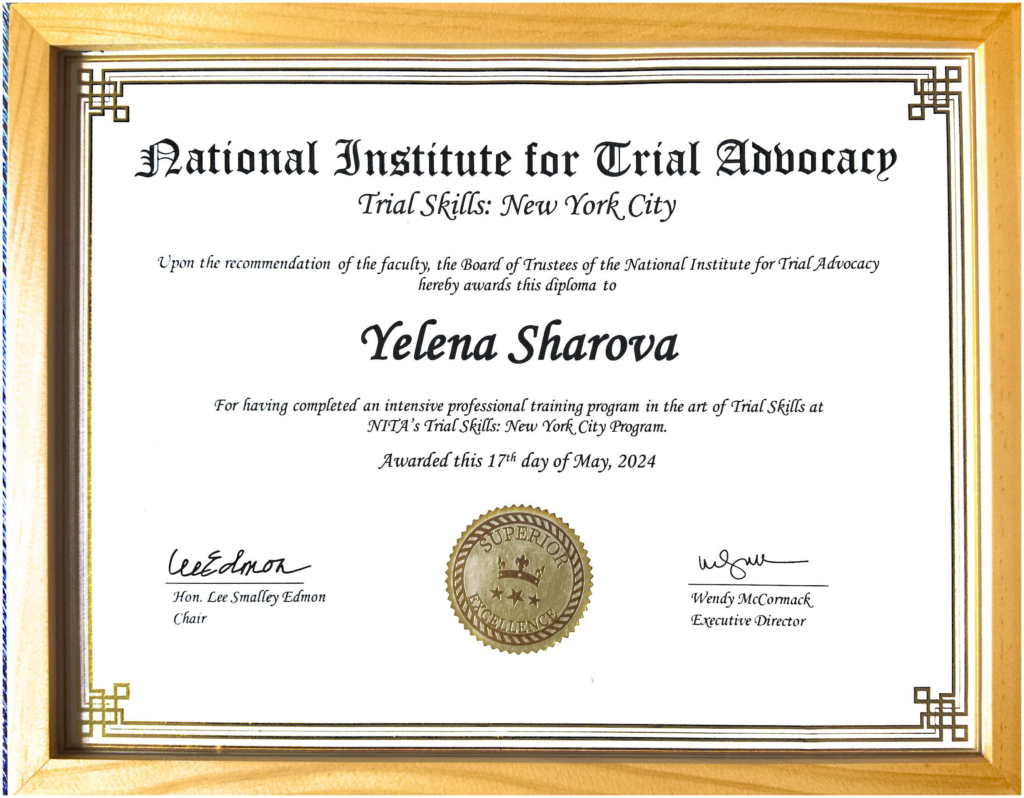
In 2024, she completed the National Institute for Trial Advocacy’s intensive professional training program, Trial Skills: New York City, and received a diploma dated May 17, 2024.
This practical training complements the firm’s case-by-case approach to evidence, witness preparation, courtroom presentation, and client advocacy.
WHY CLIENTS TURN TO SHAROVA LAW FIRM
Our approach to contested matters is based on preparation, communication, and a clear understanding of the client’s objectives.
Clients receive:
♦ A strategy developed around the specific facts of their case;
♦ A clear explanation of the procedural stages and available options;
♦ Preparation for negotiation, hearings, and trial rather than reliance on a single outcome;
♦ Attention to evidence, credibility, deadlines, and courtroom presentation;
♦ Insight from attorneys working across criminal, civil, family, and matrimonial matters;
♦ A candid assessment of both the strengths and risks of the case.
No attorney can guarantee a particular result. We can provide a focused legal strategy and prepare the matter for the decisions and proceedings ahead.
SPEAK WITH A NEW YORK TRIAL LAWYER
Once a case begins moving toward a hearing or trial, deadlines, witness availability, and the condition of important evidence may change quickly. An early review can help identify the steps that should be taken now and the issues that require further investigation.
Contact Sharova Law Firm to discuss the current status of your matter, your priorities, and the available next steps.


